Software is invisible until someone uses it, so a software company’s material has to show the product doing a job: a screen, a number, a customer. It serves several readers in one sale, from the user to security and finance, and it changes with every release. Claims about security, uptime and AI need evidence behind them.
Product marketing never runs out of things to make. Wonib makes the datasheet, the battlecard, the launch post, the sales deck and the case study from the same product notes, and checks how AI assistants describe you.
Sales material in a day
Datasheets, solution briefs, battlecards and comparison sheets.
Launches
Posts, carousels, emails and video scripts for every launch.
Found by AI
See and improve how ChatGPT, Gemini and others describe your product.
Work for software and tech companies, from brief to result
A feature launch from the release notes
The brief
We ship bulk invoice approval on Tuesday. Release notes and three screenshots attached. Audience: finance managers at mid-sized companies. Voice: plain, a bit dry.
What comes back
A LinkedIn post that opens with the task the feature removes; a four-slide carousel with one screenshot and one callout per slide; a customer email of about 120 words with a single button; and three short lines for the in-app banner, each under sixty characters.
A datasheet for the security review
The brief
Procurement teams keep sending the same questionnaire. Here are our hosting region, encryption details, sign-on options, backup schedule, certifications with their dates, and the contact for security questions.
What comes back
A two-page A4 datasheet as a PDF and a Word file: the architecture in one simple diagram, a table of controls grouped under access, data and continuity, the certifications listed with the dates supplied and nothing beyond them, and the security contact in the footer.
A sales deck rebuilt on the new template
The brief
Our sales deck is 31 slides on last year’s template. The new company slide design is attached. Keep the customer numbers; cut it to something a rep can present in fifteen minutes.
What comes back
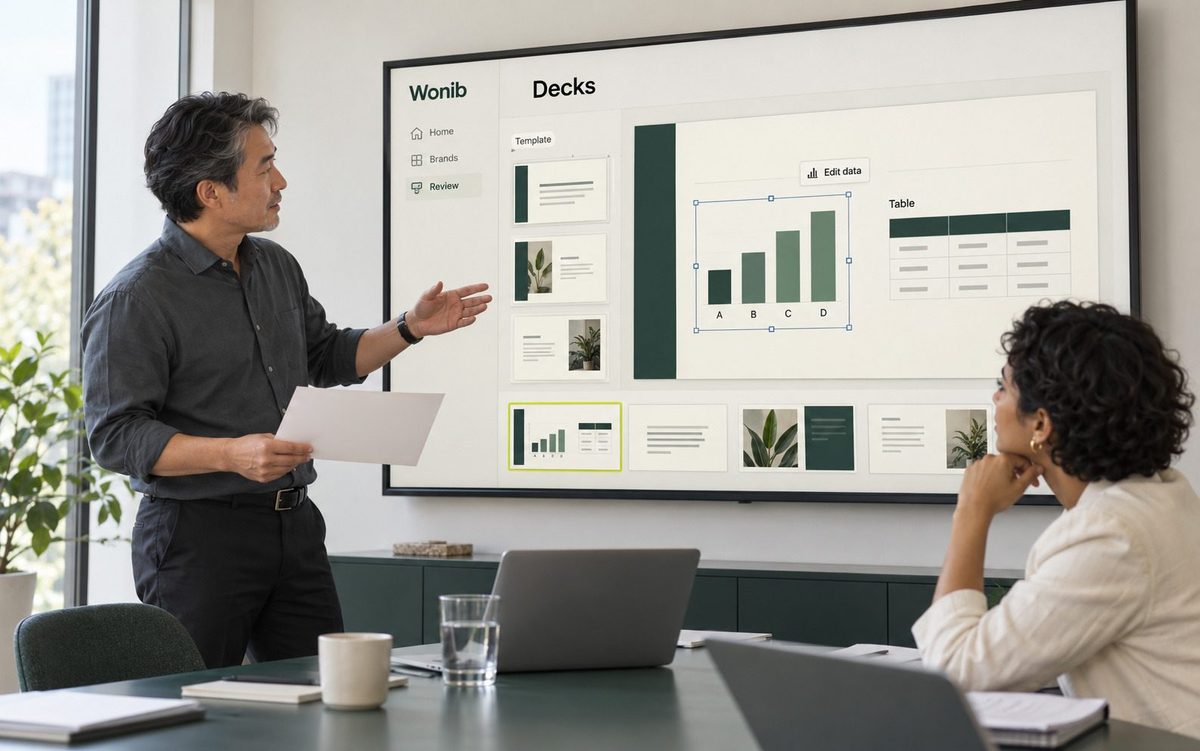
Twelve slides in the new design: the buyer’s problem, the product in three screens, two customer results with their sources, the pricing approach, a security summary and the next step. The adoption chart is rebuilt as a native chart from the original figures and stays editable.
A week of marketing for software and tech companies
One piece a working day
Monday
A changelog post: what shipped last week, in three lines and one screenshot.
Tuesday
A how-to carousel for the one task your support inbox is asked about again and again.
Wednesday
A customer result, with the customer’s approval, told in four sentences and one number.
Thursday
A short article that answers one question buyers type into search, written answer-first.
Friday
A sixty-second screen recording of one feature, narrated by the person who built it.
What software and tech companies ask before they start
Can we say we are certified, and that the product uses AI?
Say exactly what an auditor or a customer’s security team could verify. Name a certification only if you hold it, with its scope and date; “in progress” is not “certified”. For AI, state what it does, what data it uses and where a person reviews the output. A vague claim tends to resurface later, in the buyer’s security review.
The product changes every fortnight. How do we stop material going stale?
Tie material to the release calendar. Keep one list of every piece that shows the interface, with the date of its screenshots, and review that list at each release. Prefer cropped screens that show a single function over full-window captures, because a small crop survives a redesign of the navigation.
Legal wants to approve every customer name and number. Is that reasonable?
Yes. A customer’s logo, name and results belong in public material only with their written approval, and many contracts say so. Ask at the moment the customer is happiest, have the exact wording signed off, and file the approval alongside the piece so the next person can reuse it with confidence.
Can Wonib make a battlecard?
Yes, along with datasheets, comparison sheets, ROI sheets and case studies.
Can it help us show up in AI answers?
Yes. AI search visibility scores your pages and rewrites them so AI answers can quote them.
Words to get right when you market to software and tech companies
uptime
the share of time the service was available over a stated period; never “100%”
integration
a maintained connection to another product; not a word for a one-off export
seat
one named user who can sign in; say whether you charge by seat or by usage
single sign-on
signing in through the customer’s identity provider; name the ones you support
general availability
released to every customer; distinct from beta and early access
Guides for software and tech companies, by kind of work