Company profile template: the format and what to write
A company profile tells buyers who you are, what you do and why to trust you. The format, section by section, and a free template you can copy and fill in.
By The Wonib team

A company profile is a short document that tells a buyer, partner or tender committee who you are, what you do, what you have already delivered and how to reach you. The usual format runs in this order: cover, about us, services, work and proof, how you work, team, company facts and certifications, and contact. Below is a company profile template in that order, with what to write in each section.
A company profile is often written in a hurry, when a large customer asks for one before a vendor meeting, and it ends up as a brochure with a mission statement on page two and the useful facts hidden at the back. A good profile works the other way round. It answers the questions a careful buyer asks, in the order they ask them, and makes checking easy.
What is a company profile, and who reads it?
A company profile introduces the whole business, not one product. People ask for it when they are deciding whether to deal with you at all:
- A buyer's purchase or vendor team, before adding you as a supplier.
- A tender or bid committee, alongside the technical and price documents.
- A distributor, franchise partner or investor, before a first meeting.
- A large customer's project lead, who has to explain to a manager why they picked a small firm.
Each is checking two things: can this company do the work, and is it safe to deal with. Everything in the profile should help with one of those.
If you sell in India, add the registration details that apply to you on one page: the legal name and registered office, and identifiers such as your GSTIN, the CIN if you are a company, and the Udyam registration number if you are a registered micro, small or medium enterprise. Check the buyer's vendor form for anything else it asks for. Having them in one place saves a round of emails.
The company profile format, section by section
| Section | What to write | Length |
|---|---|---|
| Cover | Company name, logo, one line on what you do and for whom, the year | One page |
| About us | Who you are, where you work, since when, what you are known for | Half a page |
| Services or products | Each one with who it is for and what the customer gets | One to two pages |
| Work and proof | Named projects or customers you have permission to name, with dates and what was delivered | One to three pages |
| How you work | Your process from first call to handover, and what the customer does at each step | Half a page |
| Team | The people a customer will deal with, with their roles | Half a page |
| Company facts | Legal name, registration numbers, offices, licences, certifications you actually hold | One page |
| Contact | One named person, phone, email, address, website | A short block or the back page |
As a starting point, that comes to about 6 to 12 pages for a small or mid-sized firm. A one-page version, often called a business profile, is worth having too, for email and WhatsApp:
[Company name] · [What you do, for whom] · [City]
About: [two sentences]
Services: [three to five, one line each]
Recent work: [two projects, with years]
Facts: [legal name, registration numbers, certifications you hold]
Contact: [name, role, phone, email, website]
A company profile template you can copy
Paste this into a document and fill in the brackets. Delete any line you cannot fill with something true.
COVER
[Company name] · [What you do, for whom, in one line] · [City] · [Year]

ABOUT US
[Company name] is a [type of business] in [city or region], working since [year].
We [what you do] for [who you serve].
We are known for [the one thing customers come back for].

SERVICES
[Service 1]: for [type of customer]. They get [result or deliverable].
[Service 2]: for [type of customer]. They get [result or deliverable].
[Service 3]: for [type of customer]. They get [result or deliverable].

WORK AND PROOF
[Project or customer, if you may name them] · [Year] · [What you delivered] · [What changed for them]
[Project or customer] · [Year] · [What you delivered] · [What changed for them]

HOW WE WORK
1. [First call or site visit]  2. [Proposal]  3. [Delivery]  4. [Handover and support]

TEAM
[Name], [role]: [one line on their experience]
[Name], [role]: [one line on their experience]

COMPANY FACTS
Legal name: [ ]  Registered office: [ ]  Year founded: [ ]
Registration numbers that apply (for example GSTIN, CIN, Udyam): [ ]
Certifications and licences: [only those you hold, with numbers]

CONTACT
[Name], [role] · [phone] · [email] · [website] · [address]
How to write each section
Cover
The name, the logo and one line on what you do and for whom. Add the month and year, so a reader knows how current it is, and one photograph of your real work if you have a good one.
About us
Write it for a stranger with ninety seconds. Say what you do in plain words in the first sentence. "We design and install rooftop solar for factories in Gujarat" beats "We are a customer-centric organisation committed to excellence". Leave the vision and mission statements out, or keep them to one line each at the end.
Services or products
List what you sell the way a customer would describe it. For each one, say who it is for and what they get. Group a long list into a few families and put the rest in an appendix.
Work and proof
Make every claim here easy to check. Name projects and customers only where you have permission. Where you can't name them, describe them precisely, using only details you have verified and may share: "a 200-bed hospital in Pune" (if that is the true size and the customer is happy for you to say it) tells a reader more than "a leading healthcare provider". Give the year and what you actually delivered. Leave out any figure you can't show the source for, if asked.
How you work
Give the steps from the first call to handover in four or five short lines, and say what the customer does at each one. Be clear about the buyer's side of the work: how much of their team's time it will take, and when.
Team
Show the people a customer will actually deal with, with their roles and one line each on their experience. A small team shown honestly reads better than an org chart.
Company facts
Put every registration number, licence and certification on one page, so a purchase team can check them in one go. List only what you hold today, with its number and, where it has one, its expiry date. A certification "in progress" belongs in a cover letter, not here.
Contact
Name one person. "info@" addresses and a general phone line make a busy buyer guess who to call. Give a name, a role, a direct number and an email, so the reader knows exactly who to contact.

Company profile examples by industry
The format stays the same across industries; what changes is what counts as proof.
- IT and software: services, the industries you know, technologies and partner certifications, delivery model and security practices. See the IT company profile template.
- Manufacturing: plant, capacity stated only as you can prove it, quality systems, the industries you supply and export markets. See the manufacturing company profile template.
- Real estate: delivered projects with dates and areas, work under way, approvals, quality and leadership. See the real estate company profile template.
- Studios and agencies: how you work and a few projects told properly, with photographs, as in Studio Huisje's profile above.
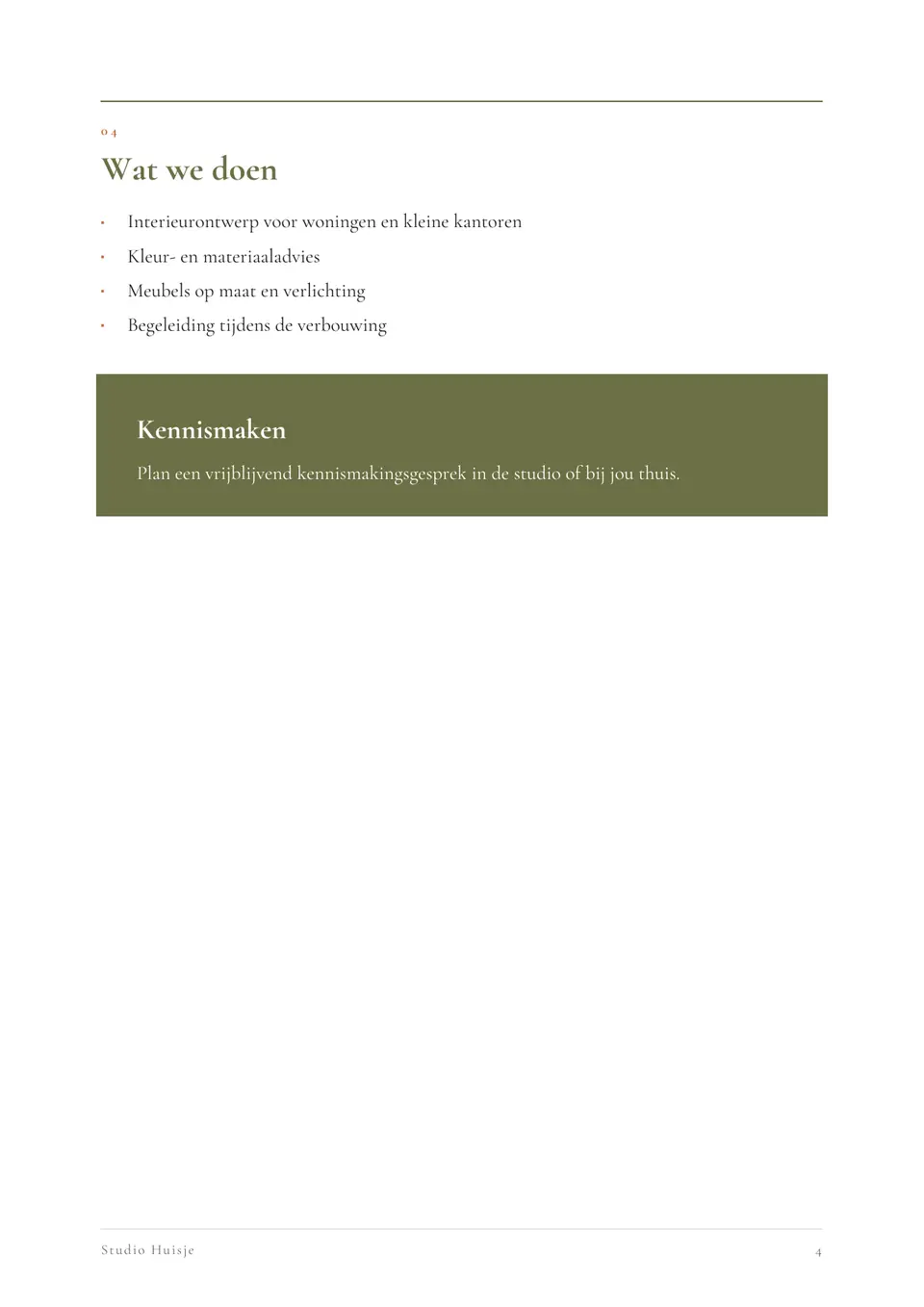
You can see the whole piece, page by page, in the showcase.
PDF, Word or a presentation?
- A PDF is the right default: it travels well by email and WhatsApp. Keep a screen version with working links, and a print version for handing out.
- A Word file is useful when a partner or a bid team needs to paste your sections into their own document.
- A presentation suits a first meeting, when you are in the room to talk through it. Cut it to the cover, about us, three services, two projects and contact, and send the full PDF afterwards.
Mistakes that make a profile look generic
- Opening with a mission statement. Open with what you do.
- Claims nobody can check. "Leading", "trusted by hundreds" and "unmatched quality" read as filler to a purchase team. Specific projects, dates and certificates read as proof.
- Stock photographs. A plain photo of your real team or work does more than a handshake in a glass office.
- Old facts. An outdated address, a former director or an expired certificate makes a reader doubt the rest. Put a date on the cover and review it twice a year.
- No single contact. Make it obvious who to call next.
Making a company profile in Wonib
Wonib makes a company profile as a document in your brand: an about section, your services as cards and a contact block, in your colours, typefaces and voice. You give it the facts (your services, projects, registration details and contact) or paste the notes you already have, and it writes and lays out the pages. It is told to use only the figures, names and quotes you give it, and not to fill a gap with an invented one, so check that every fact you want is in your notes. You get a Word file, a print-ready PDF with bleed and crop marks, or a screen PDF with working links.
If you would rather write it in your own AI assistant, our company profile prompt asks for the same sections in the same order.
Questions people ask
What should a company profile include?
A cover, about us, services or products, work and proof, how you work, your team, company facts such as registration numbers and certifications, and one named contact. Keep each section short and specific.
How long should a company profile be?
Long enough to answer a buyer's questions, short enough to read in one sitting. About 6 to 12 pages is a good starting point for a small or mid-sized firm, plus a one-page version for email.
What is the difference between a company profile and a brochure?
A brochure sells a product, a service or an offer. A company profile introduces the whole business, so a buyer or partner can decide whether to work with you at all.
What is the best format for a company profile?
A PDF for sending and reading, Word when someone else needs to edit it, and a short presentation for a meeting. The order of sections stays the same in all three.
Is there a free company profile template?
Yes: the outline above, and the one-page business profile version, can be copied into any document. For industry versions, see the IT, manufacturing and real estate company profile templates on Wonib.
How often should I update my company profile?
Whenever something a buyer would check changes (an address, a director, a certification), and otherwise twice a year, with the date on the cover.
Sources
- Ministry of MSME: Udyam Registration (the Udyam registration number for micro, small and medium enterprises, checked 2026-11)
